Tìr means land. In Scottish Gaelic, Welsh, Cornish, Manx, and Breton. It comes from Proto, Celtic tiros, meaning land or dry ground, and further back, from Proto-Indo-European ters “to dry.” The land that wasn’t flooded, the land that could sustain.
From ters, shared moving constants words across ancient languages:
- Latin torreō to scorch or parch
- Greek térsomai to dry up
- Sanskrit tṛ́ṣā thirst
- Old English thirst
Land. Not sea. Not flood.
A word somehow capturing a world we barely understand but know we are a part of. As the ice age melted, dry land. As we looked for a space to be from travel, dry land.
Pictured
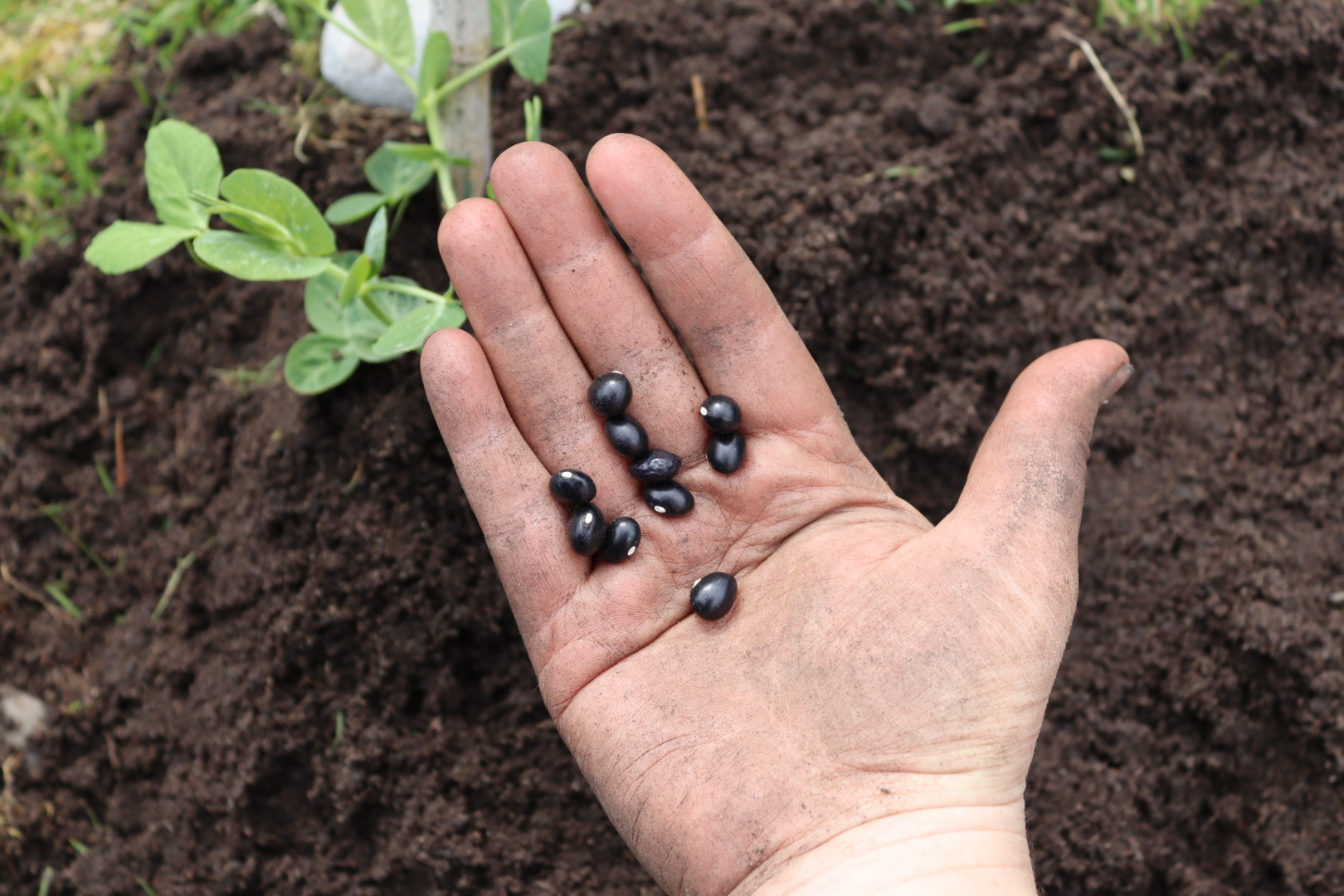
Ukranian Climbing French Beans. Waldimier Malyckuj was still growing these in his allotment until 92. He grew the climbing beans. He sang to them in Ukrainian, they grew for him.
Llanover Peas, during the First World War, a German soldier was held as a prisoner working on the Llanover estate. After the war ended, he returned to Germany but came back again to marry a Welsh girl. The peas, a love token, were grown on the estate for many years after that.
Cultivation as an act of care
These are not myths. They are stories about care, preservation, and love.
Seeds planted in real soil and kept alive through hard times, not limited by borders.
Tìr may start as a word for land. But in stories, it becomes more a mix of song, memory, and survival.
It grows from spoken words and silent understanding. It lives in small spaces, where land and story meet. Told by many voices, each with its own view, each connected by care for the land.
It’s not just dirt. It’s ongoing renewal of work, of diversity, both cultural and biological. Everything returns to a shared sense of connection. Beyond what we thought we knew.
Toward a new way of seeing how land is cared for and valued.This shared space shapes who we are. Each of us holds the world in our own way, and from that, culture grows.
Our connection to the landscape is unique. We express that connection through understanding, shaped by shared roots.
Every language gives a view of the land and climate it comes from. Personal stories become shared ones. They keep culture from becoming a single way of thinking.
The link between land and culture is hard to define. But it’s strongest in the voices of communities. It lives in language, history, secrets, and the everyday moments. Especially it lives in those who work with and within the land. The words they use help us understand who we are and where we are and who we might become. If only we listen.
 Naomi heath